


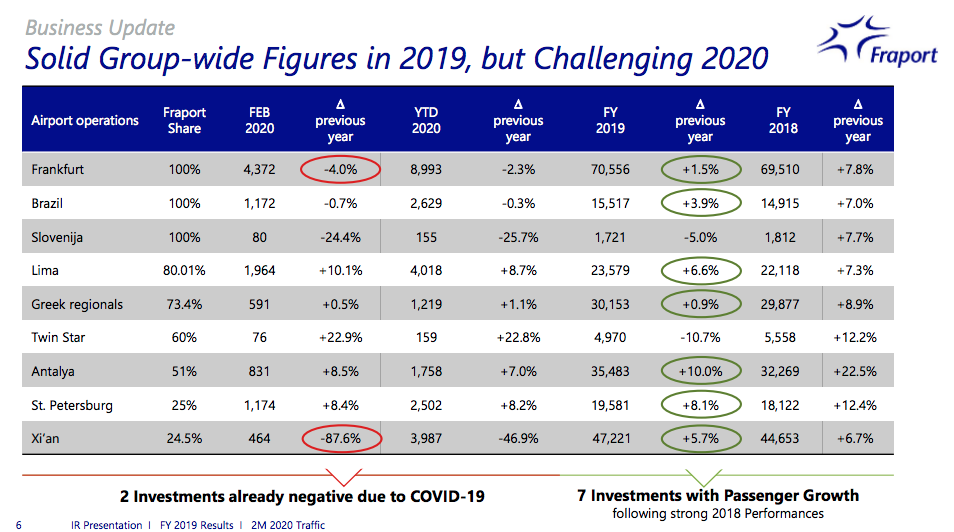
GERMANY. Frankfurt Airport owner Fraport Group today reported a solid set of results for 2019, but warned of the impact of COVID-19 on traffic, revenues and profits in 2020. Passenger traffic fell by -4% year-on-year in February, accelerating to -14.5% in the final week of the month, the company said, with volumes falling by -30% in the first week of March (more below).
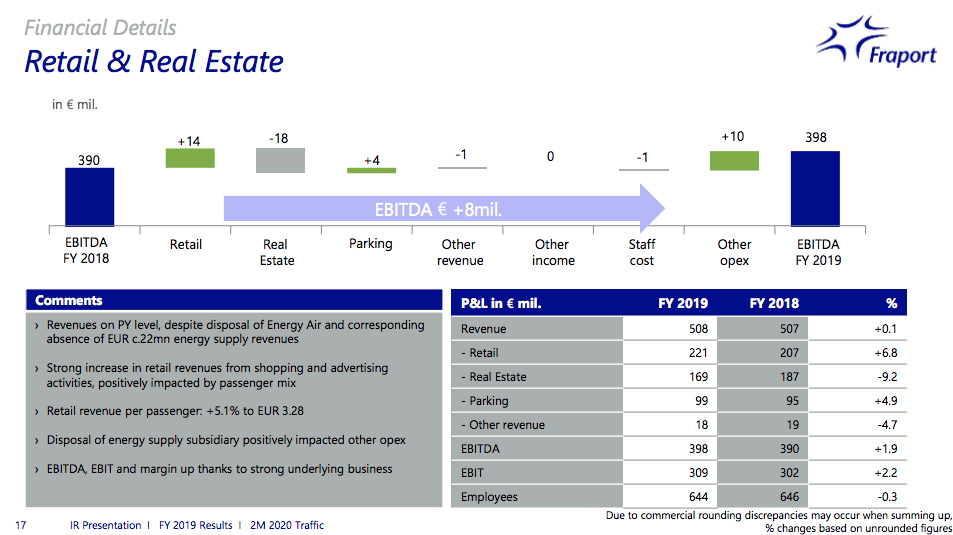
In 2019, Retail & Real Estate revenue increased marginally (+0.1%) year-on-year to €507.8 million. This is despite the loss of revenue from the Energy Air division whose shares were sold on 1 January 2019. Within retail, revenues climbed +6.8% to €221 million, buoyed by passenger traffic growth and an improved passenger mix, while car parking grew by +4.9% to €99 million.
The key figure of net retail revenue per passenger climbed by a healthy +5.1% year-on-year to €3.28.
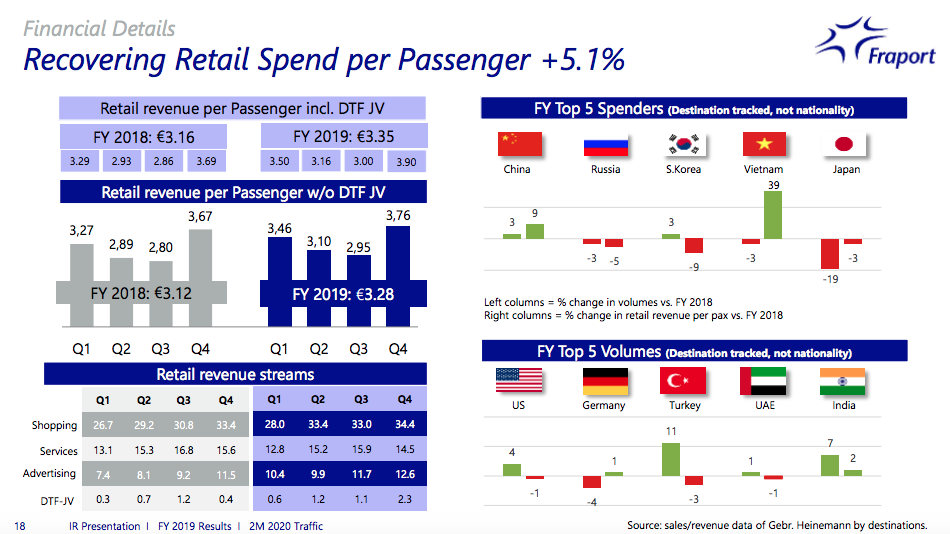
The top five spending groups were travellers on flights to China, Russia, South Korea, Vietnam and Japan, with Vietnamese showing the highest rate of increase in spend per passenger (+39%), with Chinese at a healthy +9%.
EBITDA within the Retail & Real Estate division hit €398 million, up by +1.9%.
 Fraport Group revenue overall grew by +6.5% to about €3.7 billion. After adjusting for revenue related to capital expenditure for expansion measures, revenue increased by +4.5% to nearly €3.3 billion. Traffic growth played a role in this, alongside strong contributions from Frankfurt Airport, plus the Fraport Greece, Fraport USA and Lima (Peru) subsidiaries.
Group EBITDA climbed by +4.5% to almost €1.2 billion. with net profit down by -10.2% to €454.3 million. This decline can be mainly attributed to lower ‘other operating income’ versus fiscal 2018, when this line was boosted by extra revenue from the sale of Fraport’s stake in Hannover-Langenhagen Airport. Adjusted for this one-off effect, the group result posted underlying growth of about €24 million or almost +6% in 2019.
Frankfurt Airport posted an annual traffic record in the year, up +1.5% to 70.5 million passengers. Most of Fraport’s airports worldwide also recorded traffic growth, led by Antalya (up 10% to over 35.5 million passengers), St. Petersburg Pulkovo (up +8.1% to 19.6 million), and Lima (up +6.6% to 23.6 million).
COVID-19 crisis
On the unfolding COVID-19 crisis, Fraport Executive Board Chairman Dr. Stefan Schulte said: “After many years of strong growth, the aviation industry now finds itself in a severe crisis. At this stage, it is not yet possible to foresee when the crisis will end. Even before the coronavirus outbreak, our company was navigating in a more difficult market environment.
“In the last quarter of 2019, our business was impacted by a number of negative factors: including the economic slowdown, greater geopolitical uncertainties, consolidation of flight offerings, and bankruptcies of airlines and tour operators. Despite these adverse factors, our group delivered a strong performance by achieving all financial targets in 2019. This was also largely possible thanks to our diversified international portfolio.”
Fraport said it has launched a number of cost-reducing measures to counteract the current situation. All costs are now being reviewed, with only expenditure essential for business operations being authorised.
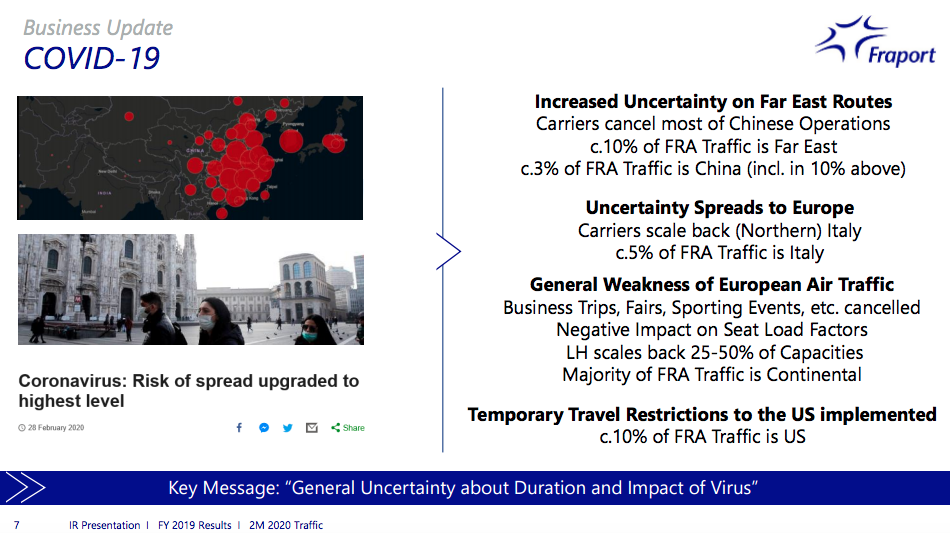
Dr. Schulte said: “We have to assume that the strong decline in air traffic volumes will continue during the next few weeks and months. At the same time, we are unable to reliably forecast the extent and duration of this development. Therefore, we cannot provide a detailed guidance for the full year 2020. Out of our responsibility towards our employees and the company as a whole, it is now vital to adjust staff deployment to the reduced demand – as fast as possible and in a socially responsible manner. We need to reduce our variable costs, wherever possible.”
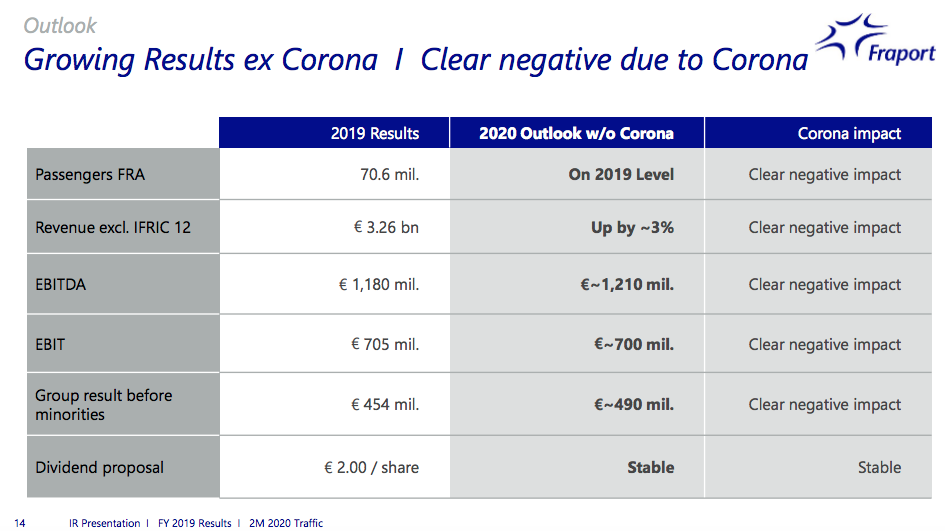
Without the coronavirus outbreak, Fraport was expecting Frankfurt Airport’s 2020 traffic performance to remain at about the same level as in 2019. Now it expects “a significant slump in passenger numbers at Frankfurt for the full year”. This will also lead to a sharp decline in revenue for the airport. The executive board currently forecasts the traffic loss to result in a negative EBITDA effect of about €10 to 14 per missing passenger.
In addition, said the company, the impact of the coronavirus outbreak on passenger traffic at Fraport’s other airports could have further dampening effects on revenue and other key financial figures.
“Overall, the executive board expects group EBITDA, group EBIT and the group result (net profit) to noticeably decline over the full year. Nevertheless, the executive board intends to maintain a stable dividend of €2.00 per share for fiscal 2020.”