





GERMANY. Frankfurt Airport owner Fraport has said it may take “quite a few years” to reach traffic levels achieved in 2019, given the severe impact of the COVID-19 crisis.
Speaking as Fraport released Q1 results today, Executive Board Chairman Dr. Stefan Schulte, said: “We’re experiencing global aviation’s worst-ever crisis. Despite timely and comprehensive action to reduce costs, the situation is severely impacting our company.
“It isn’t possible at this time to make an accurate forecast for the year as a whole, since we don’t yet know how long the travel restrictions will remain in place or how far the global economy is likely to contract. One thing is certain, however: the post-pandemic aviation industry won’t be the same. But we’re getting our airport and company ready to face the challenges.”
In the first three months of 2020, Fraport’s net profit went into negative territory (-63.7% to €35.7 million) for the first time since the group IPO in 2001. All group companies in Fraport’s international portfolio – the exception being Lima, Peru – also reported negative results in the quarter.

Group revenue dropped -17.8% to €661.1 million in Q1. Adjusting for revenue related to capital expenditures for expansion measures (based on accountancy method IFRIC 12), group revenue declined by -12.6% to €593.2 million. Group EBITDA, at €129.1 million, was -35.6% below the figure for the corresponding quarter last year.
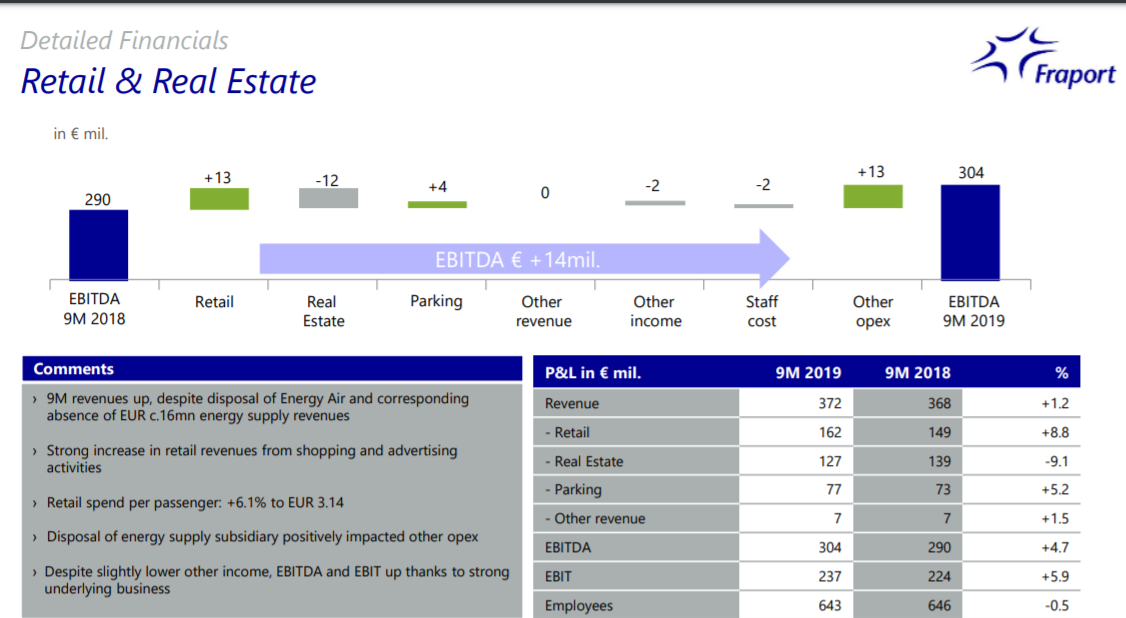
Revenue in the Retail & Real Estate division fell by -12.5% year-on-year to €101.7 million, with lower retail and parking income due to the sharp drop in passenger traffic at Frankfurt Airport (-24.9% to 11.1 million). Net retail revenue per passenger increased slightly (+4.3%) to €3.61, though off a much smaller passenger base.
Since Q1, passenger traffic has continued to fall, and was down by as much as -97% during April on a week-to-week basis.

Cost-cutting measures
Fraport said that more than 18,000 of its 22,000 employees in Frankfurt are now working reduced hours; the average for the overall workforce will be about 60% below normal in April and May to date. The company has also consolidated operations: Frankfurt Airport’s Northwest Runway and Runway 18 West have been shut down for the time being. Passenger processing now takes place in Terminal 1 Concourses A and B, and until further notice there are no passenger flights at Terminal 2.
Fraport said it remains optimistic about the long-term prospects of the aviation market and will continue with strategic projects to expand capacity. These include the construction of Terminal 3 at Frankfurt Airport, as well as expansion projects in Greece and Brazil. Construction work at Lima Airport has been held up by the airport’s temporary closure.
With the uncertainty about the market, Fraport said it cannot make detailed forecasts, but it expects a negative group result (net profit) for the full year.
Dr. Schulte said: “There have hardly been any passengers at Frankfurt Airport during the past six weeks. But we’re keeping it open, since it’s a vital gateway for ensuring Germany’s supply of freight and merchandise. The economic impacts will be even more pronounced in the current quarter than during the reporting period, since in January and February passenger volumes were still at almost normal levels.
“Currently we’re focusing on determining how we, both as part of the aviation industry and as Frankfurt Airport, can reliably ramp up operations again when the time comes. In this globalised world, aviation will continue to be a major driver of economic growth and prosperity. We therefore remain confident that we will see sustained growth again over the long term. Nevertheless, it may take us quite a few years to climb back up to the passenger figures of 2019.”