


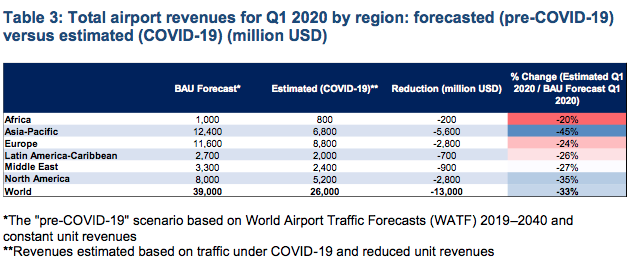
INTERNATIONAL. The latest economic analysis by Airports Council International (ACI) World has found that the COVID-19 pandemic will wipe out 38.1% of passenger traffic and almost half of revenues for airports in 2020.
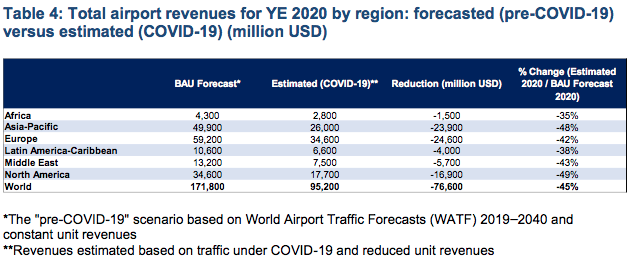
The shortfall in passenger traffic would equate to 3.6 billion passengers in absolute terms (9.5 billion originally forecast), with a severe impact on revenues. While the industry was expected to generate about US$172 billion, it is now predicted it could lose about 45% or more than US$76 billion by the end of this year.
 “A drastic decline of such magnitude for the global airport industry represents an existential threat,” said ACI World Director General Angela Gittens. “A swift, effective and equitable economic policy response from governments is needed to protect millions of jobs, protect essential operations, and give the industry the greatest chance to weather the storm and recover quickly.
“The global airport industry has faced multi-billion-dollar losses already in the first quarter of 2020, but it is now predicted that the impact of COVID-19 will extend not only to the second quarter of 2020 but also the second half of the year. Most experts in the air transport industry agree that recovery may take a year to 18 months to reach pre-crisis traffic levels and the industry may not record pre-COVID-19 traffic volumes again before the end of 2021.
“A fair and equitable global economic policy response is required to safeguard essential airport operations, to protect millions of jobs worldwide, and to ensure the survival of the industry and lay the foundation for a fair recovery.”

 While airports have high fixed and unavoidable costs, they are reducing variable costs by closing some infrastructure, postponing capital expenditure and addressing staffing costs, ACI noted.
On the prospects for recovery, ACI said it foresees faster recovery in domestic passenger traffic than international.
“In the case of international passenger traffic, the recovery will take longer as any international flight implies reciprocal permissions, while various states will emerge from the current crisis at different times with varying pace of relaxation of the recently imposed restrictions.”
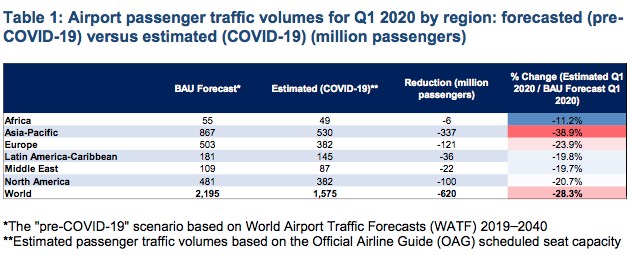
Underlining how fast the decline has occurred, ACI said that the reduction in global passenger traffic progressed from -6.9% in January to -22.9% in February and -53.1% in March (estimated). This means a -28.3% decline for the first quarter of 2020, equivalent to losing 620 million passengers.
By region, Asia Pacific appears to be the most affected in Q1 with an estimated –38.9% loss in passenger traffic, followed by Europe (-23.9%) and North America (-20.7%).
For the full year, said ACI, the reduction in traffic by the end of 2020 by region could reach 1.5 billion passengers in Asia Pacific, 0.8 billion passengers in North America and close to 1 billion passengers in Europe. Latin America-Caribbean, Middle East and Africa may lose around 250, 160 and 80 million passengers respectively, ACI said.
For the full ACI bulletin, click here.