

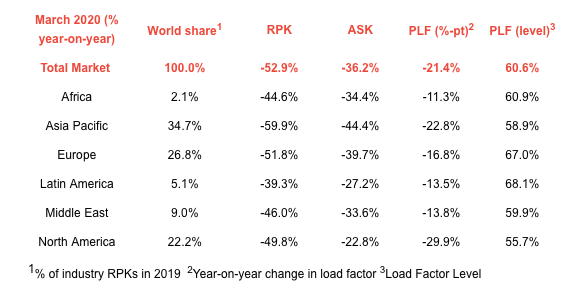
INTERNATIONAL. The International Air Transport Association (IATA) declared it a “disastrous month for aviation” as it reported global passenger traffic results for March 2020. They reveal that demand (measured in total revenue passenger kilometres/RPKs) fell -52.9% in comparison to the same month last year as governments moved to slow the spread of COVID-19.
In seasonally adjusted terms, global passenger volumes fell to levels most recently seen in 2006. March capacity (available seat kilometres) fell by -36.2% and load factor dropped -21.4 percentage points to 60.6%.
IATA Director General and CEO Alexandre de Juniac said: “Airlines progressively felt the growing impact of the COVID-19 related border closings and restrictions on mobility, including in domestic markets.”
He added: “Demand was at the same level it was in 2006 but we have the fleets and employees for double that. Worse, we know that the situation deteriorated even more in April and most signs point to a slow recovery.”
March international passenger demand – with all regions recorded double-digit percentage traffic declines – tumbled by -55.8% compared to the same month in 2019, following a -10.3% year-to-year fall in February. Meanwhile, capacity dropped -42.8%, and load factor dropped -18.4 percentage points to 62.5%.
Asia Pacific airlines were the most severely hit, as March traffic fell -65.5% compared to the year-ago period; this was more than double the -30.7% decline in February. Capacity fell back -51.4% and load factor fell by -23.4 percentage points to 57.1%.
March demand for European carriers decreased by -54.3% year-to-year, following a virtually flat year-on-year performance in February. Capacity dropped -42.9%, and load factor sank 16.8 percentage points to 67.6%, though this stands as a high among regions.
Middle East airlines posted a -45.9% traffic decrease in March, heavily reversing a +1.6% increase in February. Capacity slid -33.5%, and load factor dropped 13.7 percentage points to 59.9%.
North American carriers’ traffic fell -53.7% compared to last March, a dramatically poorer result after a -2.9% drop in February. Capacity fell -38.1%, and load factor slipped by -21.1 percentage points to 62.8%.
Latin American airlines saw a -45.9% demand drop in March, compared to the same month last year, after a marginal -0.2% year-to-year fall in February. Capacity fell -33.5% and load factor decreased -15.3 percentage points to 66.5%
African airlines’ traffic recorded the smallest fall among the regions in March (-42.8%), after a -1.1% decline in February. Capacity dropped 32.9%, and load factor was clipped by -10.5 percentage points to 60.8%
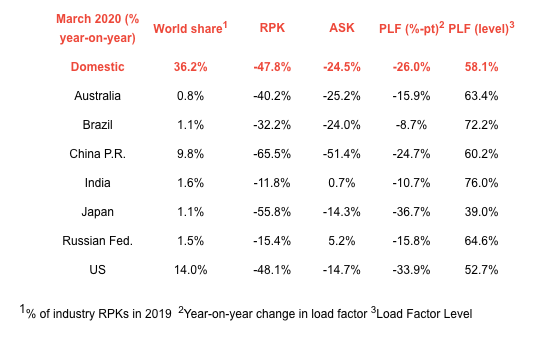
In country markets, Chinese airlines recorded the steepest declines, with domestic demand down -65.5% in March compared to March 2019. This, IATA noted, was an improvement over the -85% year-to-year decline in February as the country began to re-open domestic air travel. Meanwhile, Japan’s airlines recorded a -55.8% year-over-year decline in domestic RPKs, even though a widespread lockdown was not implemented.
Reflecting on the overall results, de Juniac said: “The industry is in free fall and we have not hit the bottom. But there will come a time – soon, I hope – when authorities will be ready to begin easing restrictions on mobility and opening borders. It is imperative that governments work with industry now to prepare for that day.
“It is the only way to ensure that we have measures in place to keep passengers safe during travel and reassure governments that aviation will not be a vector in the spread of the disease. We must also avoid the confusion and complexity that followed 9/11.
“Global standards that are mutually accepted and operationally practicable will be mission-critical to achieving this. The only way to get there is by working together.”